
On this page
One continuous section of the book; read it straight through.
Another method of approximation to the neutron transport equation is to use a functional expansion to discretize the angular variables. This method is known as the PN method. Much like how the SN equations started as a series of quadrature equations to break up the angular component, the PN method relies on a series of equations. Specifically PN expansion is based upon an expansion that corresponds to Legendre polynomials, where corresponds to the cosine of the scattering angle. As with most polynomial expansions, the series can continue to higher and higher orders resulting in a finer discretization of the angle. The higher the order, the finer the calculations and greater the accuracy and, once again, the greater cost in computational speed and memory.
Without getting into the details of the derivation, when the series expansion is truncated at N = 1 (i.e. after two terms), the angular flux takes the form of Equation 3.3. (Duderstadt and Hamilton; 1976)
Equation 3.3 is known as the P approximation to the angular flux. It is one of the simpler forms of deterministic solutions to the transport equation. The P approach is closely related to neutron diffusion theory.
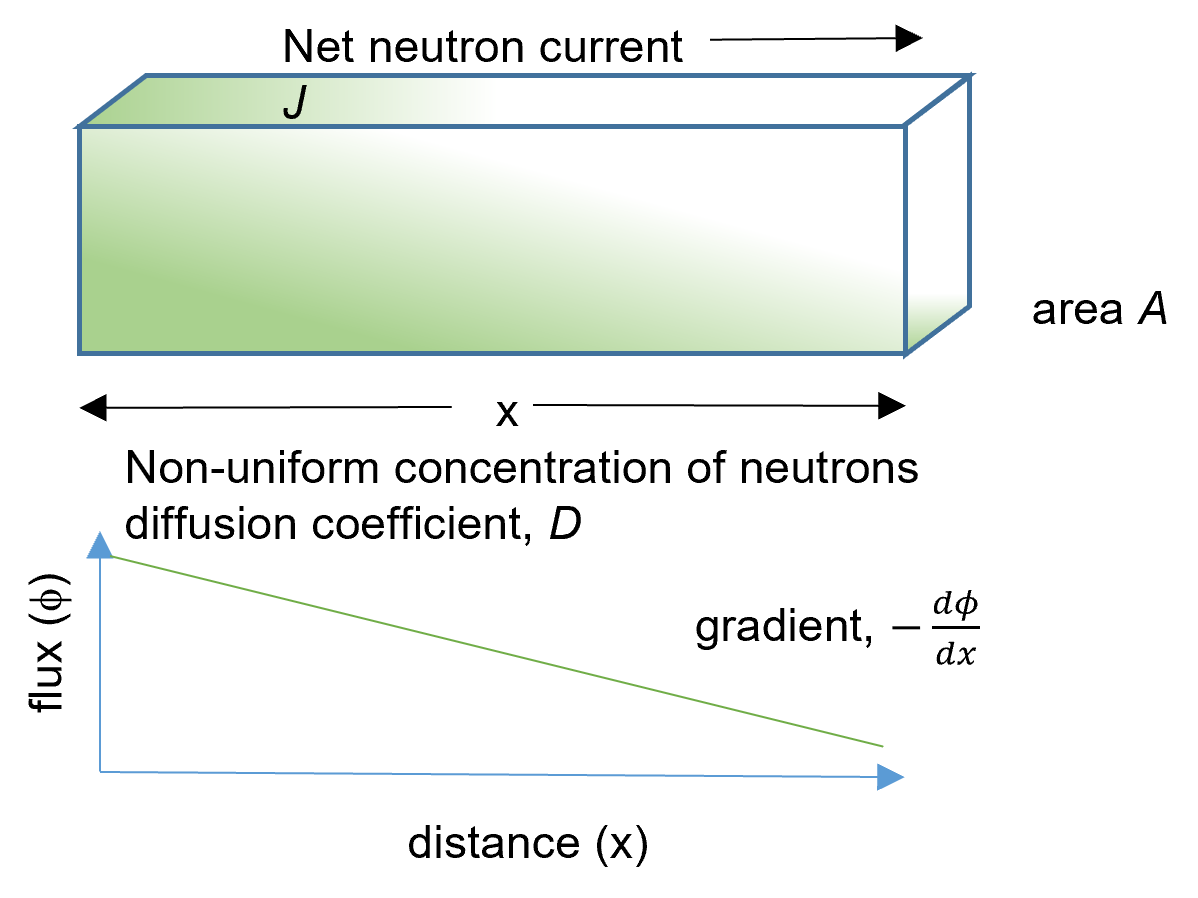
Neutron diffusion theory is based upon Fick’s law in chemistry which describes the movement of a solute in solution. As shown in Figure 3.6, the solute will travel from regions of higher concentration to lower concentration where the rate of flow is proportional to the negative gradient. Neutrons in a large system, like a reactor, will generally flow from areas of higher concentration to lower concentration much in the way that a solute moves in solution. When applied to neutron transport, Fick’s law becomes Equation 3.4. (Lamarsh and Baratta; 2001)
Where is the neutron current or the net number of neutrons traveling through a unit area per second and is the diffusion coefficient. Neutron diffusion equations lend themselves to hand calculations for simple models and rapid computer codes which can be discretized in terms of space, energy groups, and time. For many years, diffusion codes were the primary methods for solving reactor core problems because computers could not efficiently handle higher order SN or PN codes. The major drawback to the use of diffusion theory occurs in instances where the diffusion approach breaks down. This occurs at points where the problem becomes strongly dependent on angle. Namely:
Near regions of strong absorbers (such as control rods)
Near the boundary of the system
Near a neutron source
Anywhere the scattering of the neutrons are strongly an-isotropic (forward peaked such as in a beam).
In these cases, the neutron diffusion equation needs the fidelity of angle that is removed in the simplification of the problem. One approach to correcting the issue is to apply a correction factor, known as an extrapolation distance, on boundaries that forces the flux to travel to a point that it should go versus where the diffusion equation predicts it will go.
Diffusion approaches are still very useful for hand calculations and frequently taught in introductory reactor analysis courses. Even though modern computer systems have more than enough capability to handle codes that use either high order discrete ordinates methods or Monte Carlo transport to get more accurate results, diffusion theory still has many practical applications. Within high order codes, there is the possibility of using diffusion theory to help get to a solution faster within the construct of a higher order method. Additionally, core simulators will use a few-group nodal code for neutronics and couple it with another calculation for thermal hydraulics, fuel performance etc. The fact remains that large reactors contain so many individual fuel elements that the explicit modeling of each pin is unnecessary and unrealistic for many applications. (Rearden and Jessee; n.d.)
References
Full bibliography- Lamarsh, J. R. and Baratta, A. J. (2001). Introduction to Nuclear Engineering, Addison-Wesley series in nuclear science and engineering, 3rd edn, Prentice Hall, Upper Saddle River, N.J. https://books.google.com/books?vid=ISBN0201824981
- Rearden, B. T. and Jessee, M. A. (n.d.). Scale code system. URL: https://doi.org/10.2172/1426571
- Duderstadt, J. J. and Hamilton, L. J. (1976). Nuclear Reactor Analysis, Wiley New York. https://books.google.com/books?vid=ISBN0471223638