On this page
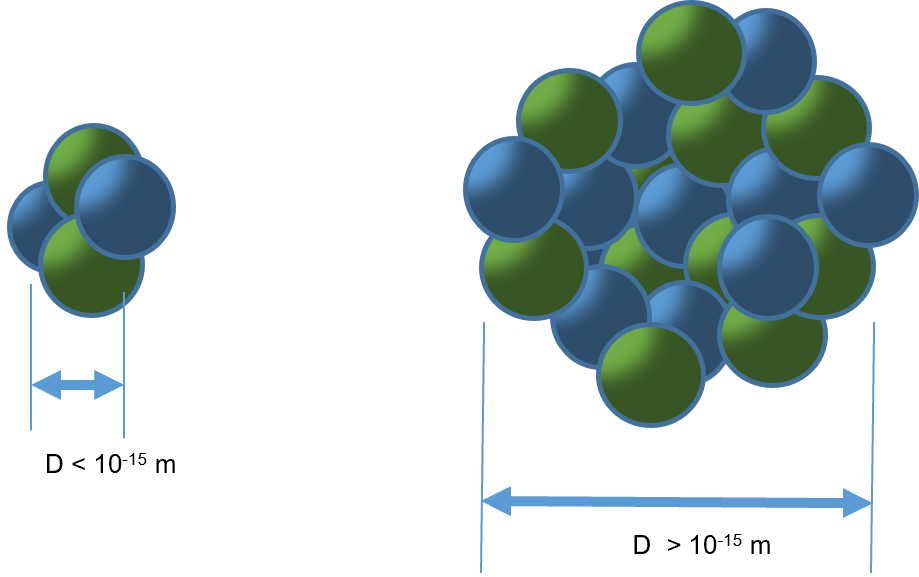
Radioactive decay is a mechanism by which an isotope spontaneously changes its nuclear form through disintegration in its nuclei. Radioactive isotopes are either naturally occurring or formed through interactive processes such as neutron capture. Regardless of their origin, the instability in the nucleus is caused by a ratio of neutrons and protons that does not support the balance between the short-ranged strong nuclear forces and long-ranged electrostatic forces. The strong forces are present in all nucleons (protons and neutrons) while the electrostatic forces are found only in charged nucleons (protons). Strong forces act over a distance of around m or the diameter of a medium-sized nucleus. For light isotopes, the distances between all nucleons are close allowing for a neutron to proton balance of 1:1. As the nucleus grows with atomic number, the distances between protons from one side of the nucleus to the other become great enough that the electrostatic forces will start to pry the nucleus apart. To bind the nucleus, more neutrons are needed to provide additional strong forces to “glue” it together. An illustration of the differences in small and large nuclei is presented in Figure 1.1.
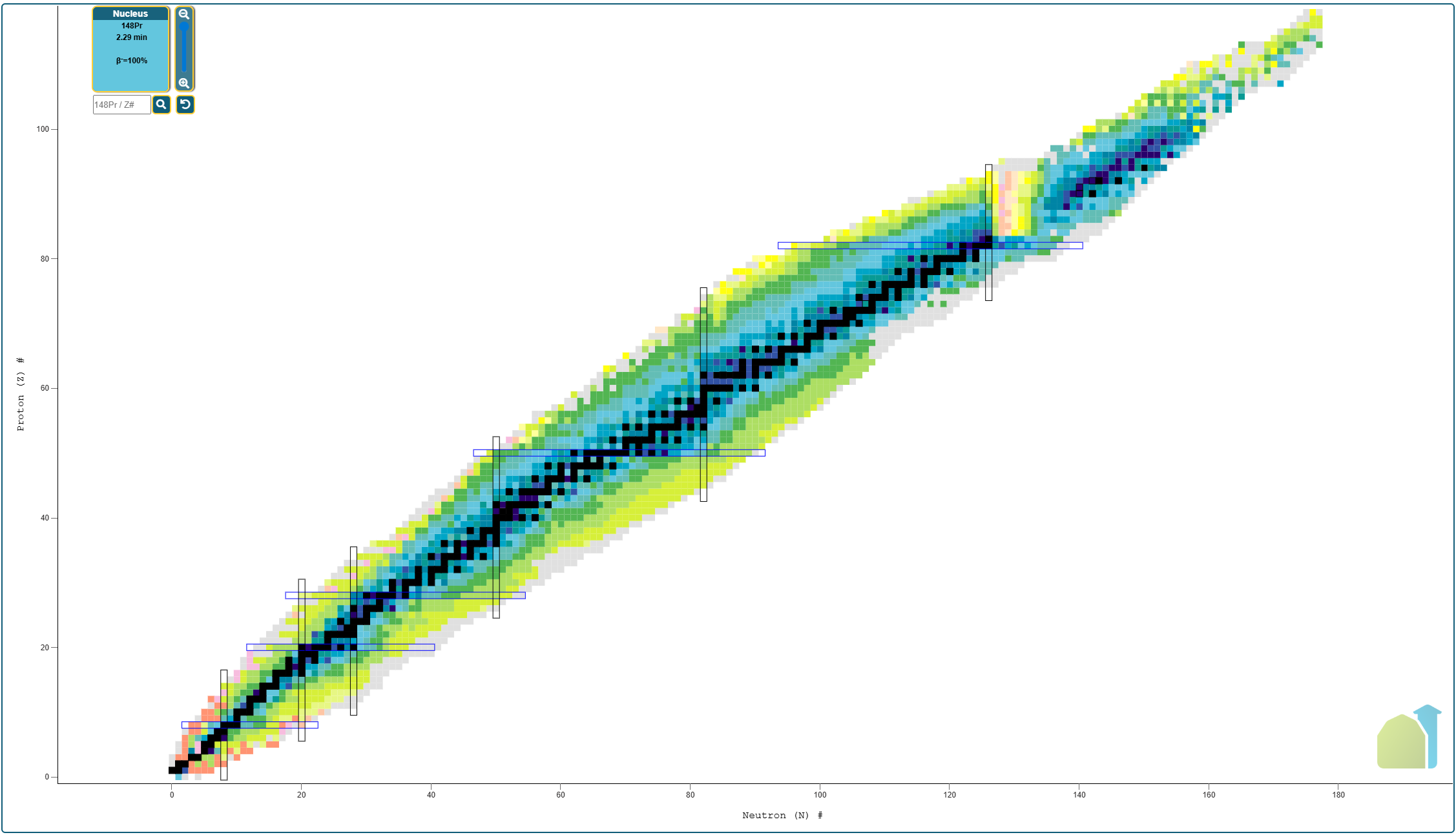
To provide the correct balance of forces, heavy isotopes will have ratios of neutrons to protons of up to 1:2 or more. The chart of the nuclides from the National Nuclear Data Center from Brookhaven National Laboratories is shown in Figure 1.2. Stable isotopes fall along the "line of stability", represented by the dark spots on the figure. Unstable isotopes will undergo decay processes in order to change their nucleus neutron-proton balance to move closer to the line of stability. Some isotopes will take several decays to eventually move to a stable isotope.
Three Primary Decay Processes
The majority of unstable nuclides will decay by one of three processes — alpha, beta, or gamma decay. In alpha decay , the atom emits a helium nucleus consisting of two neutrons and two protons resulting in a decrease in the atomic number by two and the atomic mass by four (e.g. ). Most alpha emitters are heavy nuclides such as uranium and transuranics. Beta decay can either be positive or negative. The sign of the beta decay refers to the charge of the beta particle emitted. A negative beta particle is an electron while the positive particle is a positron. During negative beta decay, the atom converts a neutron in the nucleus to a proton and emits an electron and an antineutrino. The resulting nucleus has the same atomic number as the parent but the number of protons increases by one and the number of neutrons decreases by one (e.g. ). During positive beta decay, the atom converts a proton to a neutron and emits a positron and a neutrino. The result is a nucleus with an additional neutron and one less proton (e.g. ). For both beta decay processes, the atomic mass number for the parent and daughter isotopes are the same. The third common decay process, gamma decay , occurs when the nucleus of the unstable atom transitions from one excited state to another and emits a photon. Gamma emissions often accompany another radioactive process such as a beta decay where the parent nuclide decays to a metastable daughter product with excess energy in the nucleus (e.g [662 keV]).
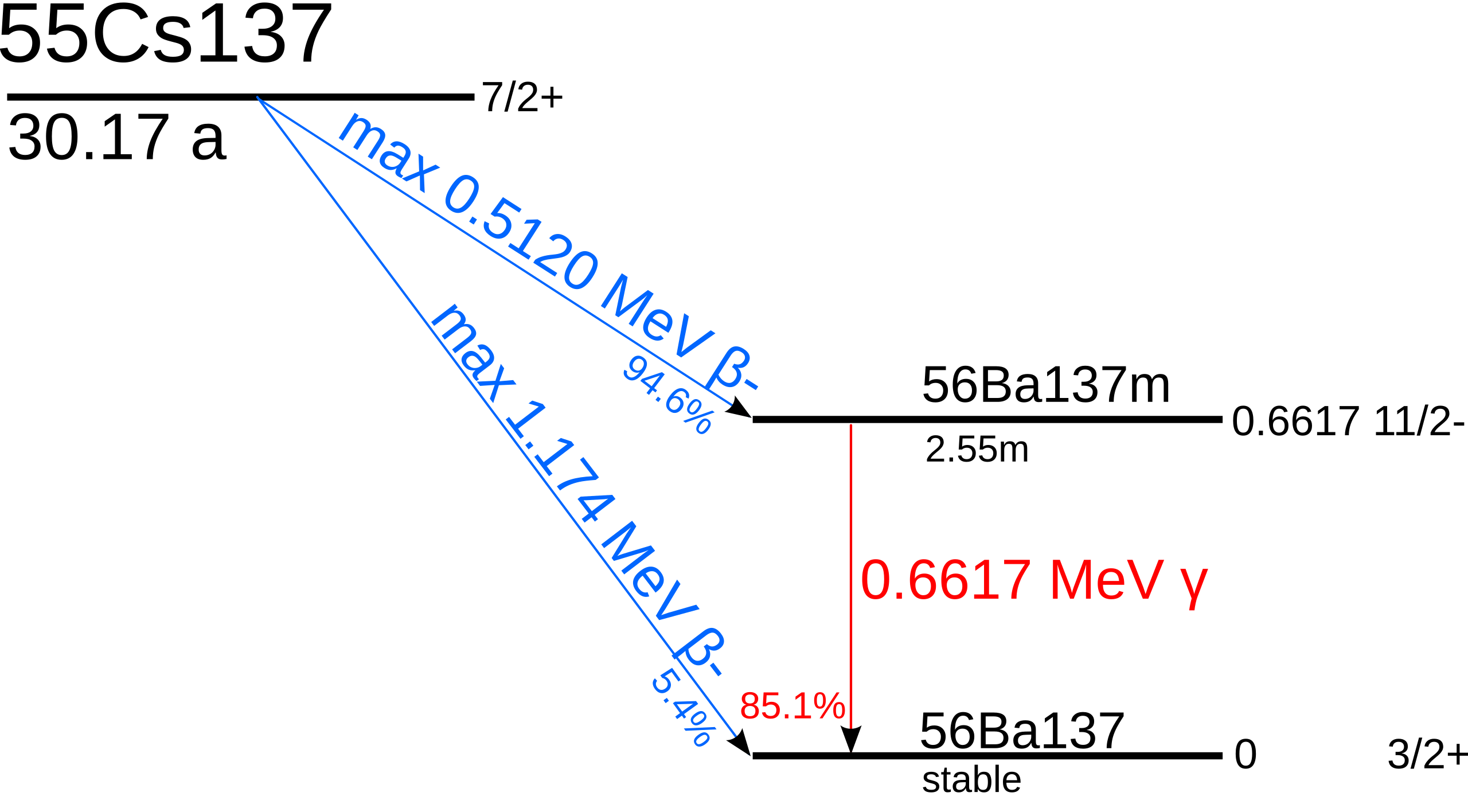
During the fission process, a significant amount of gamma rays are emitted in addition to neutrons and fission fragments. Because fission fragments are produced from the splitting of large nuclides, like uranium, they generally have many more neutrons than the number of protons that are necessary for stability. As a result, most fission fragments will undergo one or more negative beta decays to reach a stable isotope. Many of these will result in accompanying gamma emissions. A visual representation of the transitions of a radioactive isotope with the possible branches and their associated probabilities is called a decay scheme. Figure 1.3 is an example of the Cs radioactive decay scheme.
References
Full bibliography- NNDC (2025). US Department of Energy Chart of the Nuclides Database. URL: https://www.nndc.bnl.gov/nudat3/
- Podgoršak, E. B. (2009). Modes of Radioactive Decay, Radiation Physics for Medical Physicists p. 475–521. https://doi.org/10.1007/978-3-642-00875-7_11