On this page
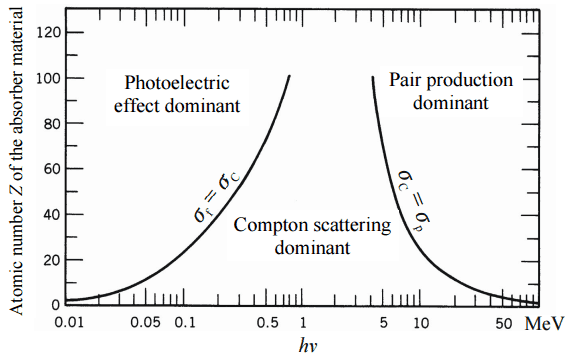
Gamma rays are photons that originate in the nucleus of an atom. How they interact with matter is well-understood and modeled. In general, gamma interactions with matter depend strongly on the energy of the gamma ray and the atomic number, Z, of the atoms in the media they are traversing. There are three primary gamma ray interactions. They include the photoelectric effect, Compton scattering and pair production.
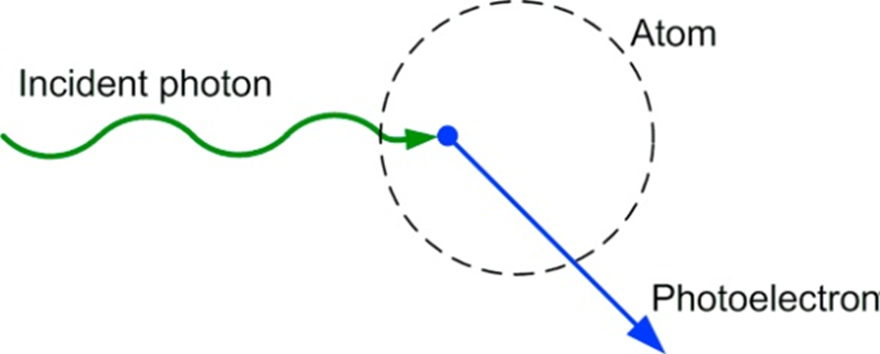
The photoelectric effect , also called photoelectric absorption, occurs when a photon interacts with an atom and disappears causing the atom to eject a photo-electron from one of its orbital shells. As shown in Figure 1.4, the interaction is with the whole atom versus the nucleus or the orbital electrons. The photoelectric effect is normally dominate at lower photon energies (E < 0.1 MeV) and increases with higher atomic number (Z). Often when an inner orbital electron is ejected, an outer electron will fall in to fill the vacancy. The difference in binding energy from the outer to inner electron shell is conserved through the emission of a characteristic x-ray. This x-ray has the exact energy corresponding to the difference in binding energy between the two shells.
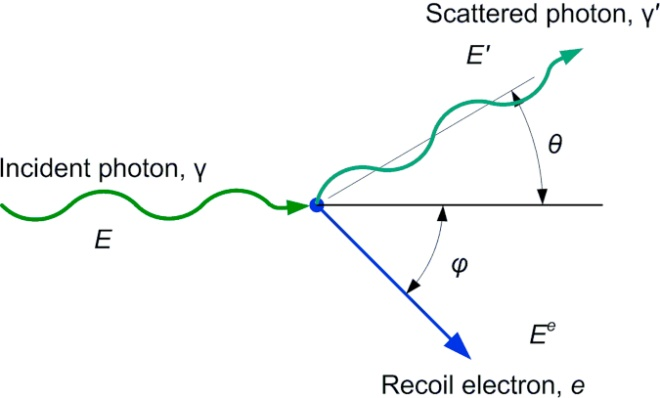
Compton scattering occurs when a photon elastically scatters off an orbital electron. In the scattering process, energy is transferred from the incident photon to the electron which recoils (Figure 1.5). The scattered photon has an energy equal to the difference between the incident photon energy and the energy of the scattered electron. Compton scattering is most prominent for photons of intermediate energies from 0.1 MeV up to 1 MeV. The angle of the scattered photon with respect to the incident photon is dependent on the energy of the photon and is described in detail in Example 2.2.
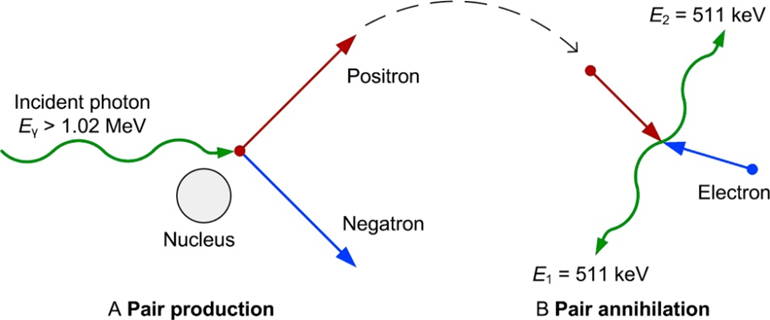
Pair Production occurs when an incident photon with an energy greater than 2 times the rest mass energy of an electron (E > 1.02 MeV) interacts with the nucleus of an atom and is absorbed (Figure 1.6). Energy is conserved by the atom emitting two particles (an electron and a positron). The threshold energy is necessary in order to have enough energy to convert to mass of two particles each with a rest mass of 511 keV. After emission, the positron will normally travel a short distance before it interacts with an electron resulting in the annihilation of the two particles and the creation of two photons, each with an energy of 511 keV traveling in opposite directions.
The total probability of an interaction occurring in a path length is expressed as the linear attenuation coefficient () given in Equation 1.4 and has units of inverse length (cm). The total attenuation coefficient is the sum of the photoelectric (), Compton () and pair production () attenuation coefficients for that particular energy photon in that media. The relationship of photon cross section probability with the energy of the incident photon and the atomic number, Z, of the material is presented in Figure 1.7.
Basic Neutron Interactions with Matter
Neutron interactions can be characterized into two broad groups – scatter and absorption. Figure 1.8 is a representation of the hierarchy of neutron interactions. Scatter includes elastic and inelastic scatter . In elastic scatter collisions, energy is transferred from the neutron to the nucleus of the scattering medium which recoils according to the laws of classical mechanics. In inelastic scatters, some of the energy of the incident neutron is transferred to the nucleus causing the target atom to become excited.
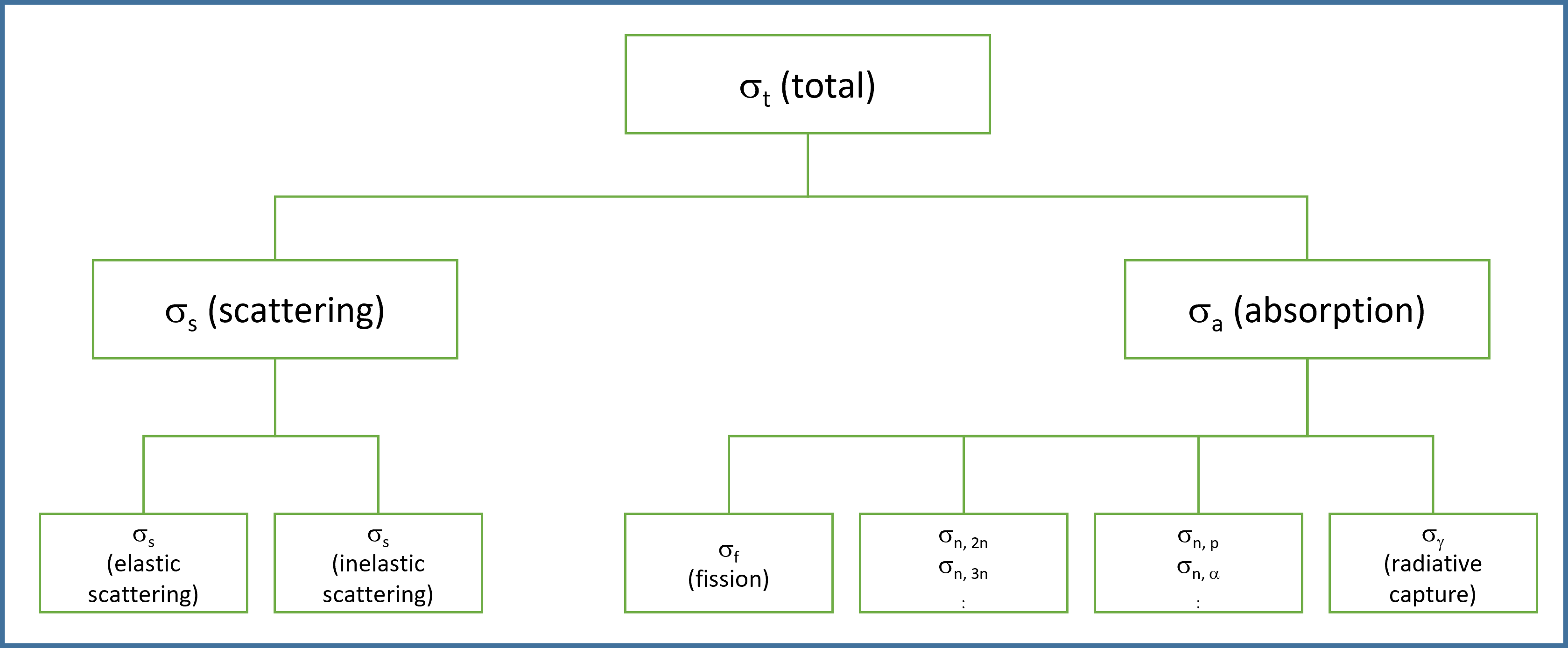
Absorption interactions include all the interactions in which the target atom absorbs the neutron. These include fission (n, f), radiative capture (n, ) and the interactions where the neutron is absorbed and another particle or multiple particles are emitted such as (n, 2n), (n, 3n), (n, p) and (n, ) interactions. The probability of an interaction occurring depends strongly on the neutron energy and the isotope of the target atom. The interaction probability is represented by a quantity referred to as the microscopic cross section () which has units of area in either cm or commonly barns where 1 barn = cm. The microscopic cross section for isotopes is measured and tabulated and based upon a single atom of that isotope. To get a linear interaction probability similar to the linear attenuation coefficient referenced for gamma rays, the microscopic cross section is multiplied by the number density () of the given material. The number density is calculated using the physical density () of the material, Avogadro’s number () and the atomic mass (M) of the isotope as shown in Equation 1.5.
The product in Equation 1.6 represents probability of interaction per unit length and is referred to as the macroscopic cross section () and has units of inverse distance (cm).
While gamma interaction cross sections can be calculated directly based upon derived and empirical formulas, neutron cross sections are more complicated and years of theoretical and experimental work has been performed to tabulate the various cross sections for hundreds of isotopes. In the United States, Brookhaven National Laboratories publishes the Evaluated Nuclear Data File (ENDF) which serves as the single source for the majority of cross sectional libraries used in US computer codes. Having good cross sectional data is essential to ensuring accuracy in any computer model. Regardless of the accuracy of the code and detail in the model, without good cross sections, the solution will not be correct. Cross sections are the foundation of all computer simulations.
Within the ENDF files, cross section reactions are assigned MT numbers. The MT numbers represent the various possible reactions and are standard regardless of the particle involved in the interaction (n, p, d, t, He-3, a, or photonuclear gamma). A partial list of MT numbers is presented in Table 1.1. A complete list of MT numbers and their meanings can be found at http://t2.lanl.gov/nis/endf/mts.html.
Table 1.1. Select Examples of MT Numbers Used in Evaluated Nuclear Data Files. (LANL; 2007)
| MT | Reaction | Description |
|---|---|---|
| 1 | (n,total) | Neutron total cross section. Sum of MT=2, 4, 5, 11, 16-18, 22-26, 28-37, 41-42, 44-45, and 102-117. |
| 2 | (z,z0) | Elastic scattering cross section for incident particles. |
| 16 | (z,2n) | Production of two neutrons, plus a residual. |
| 17 | (z,3n) | Production of three neutrons, plus a residual. |
| 18 | (z,fission) | Total fission. Equal to the sum of MT=19, 20, 21, and 38, if present. |
| 102 | (z,gamma) | Radiative capture. |
The ENDF cross sections are stored as datasets within most computer codes for specific temperatures. In some instances, cross sections may not be readily available for a particular isotope or temperature that the user’s problem requires. The computer code NJOY99 allows for the processing of raw ENDF data to reflect specific temperatures, isotopes and MT numbers for use in the Monte Carlo N-Particle (MCNP) code. This book will not demonstrate the uses for NJOY99-derived cross sections for using in MCNP, but will rather depend on the cross sectional temperatures associated within the standard ENDF libraries. In addition to use within a code, NJOY99 can be used to plot cross sections for various isotopes, energies and interactions. The raw data for NJOY99 is downloaded from the National Nuclear Data Center Evaluated Nuclear Data File online database or the ENDF Database from Los Alamos at http://t2.lanl.gov/nis/data.shtml. From the website, the user can select datasets from the US ENDF, the European JEFF, the Japanese JENDL, Chinese CENDL or Russian ROSFOND. Each major contributor may have slightly different measured values for the isotope and reaction. A similar code to NJOY99, AMPX, is used to produce cross section and libraries for use in other transport codes such as SCALE. The examples in SCALE in this book will specify temperature for cross section processing, but do not include specific instructions on using AMPX. Documentation on the use of AMPX is provided within the SCALE distribution package.
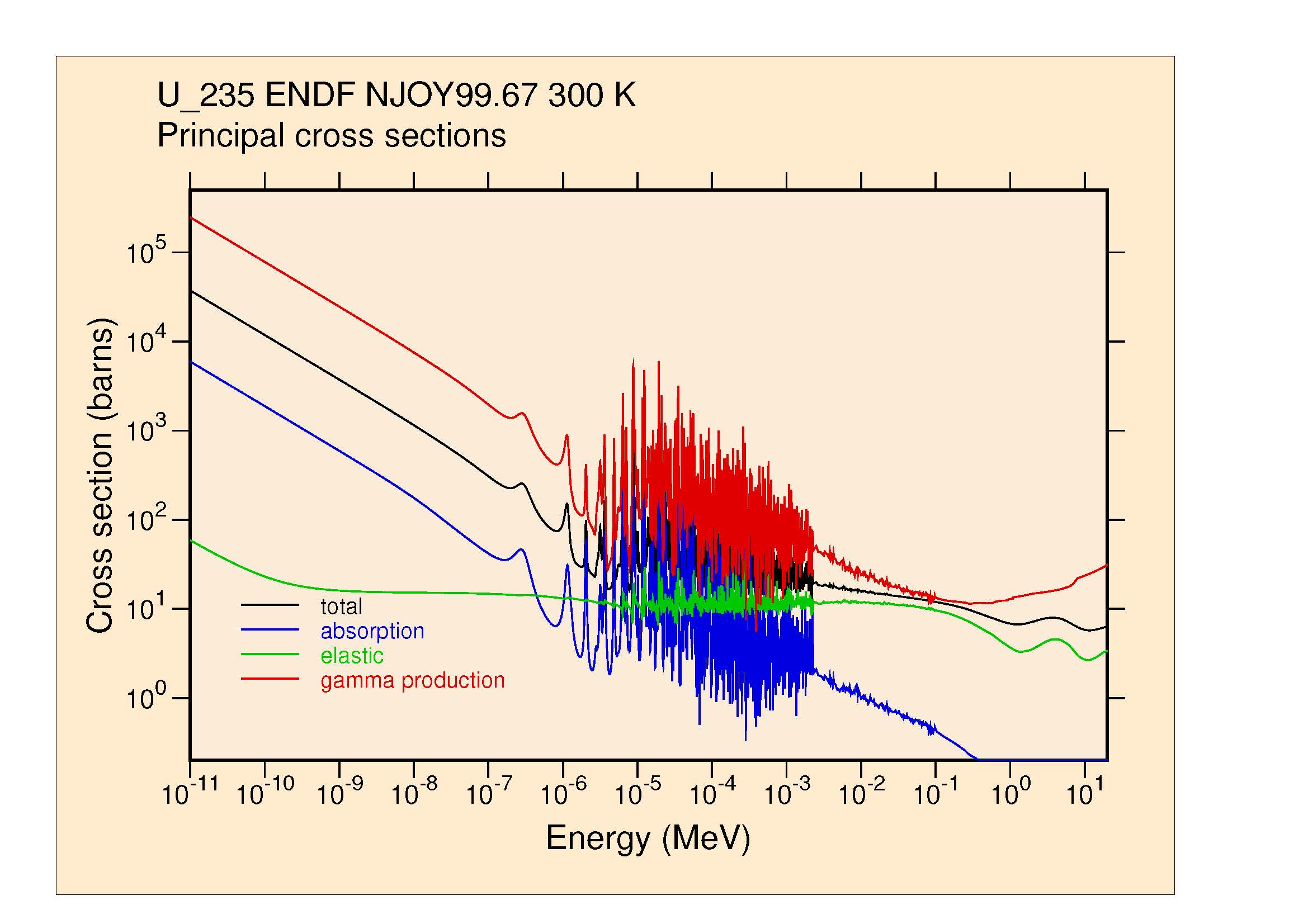
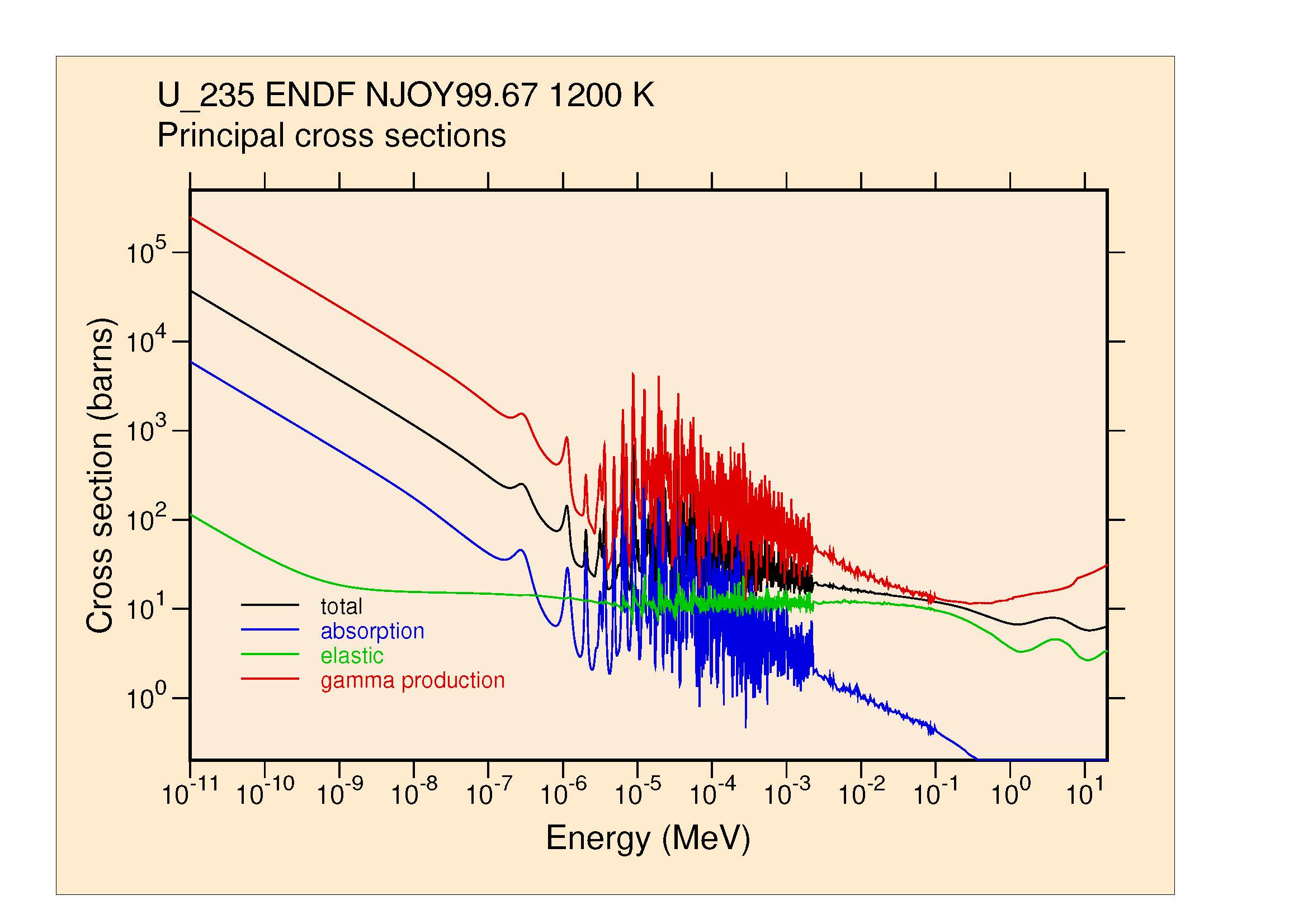
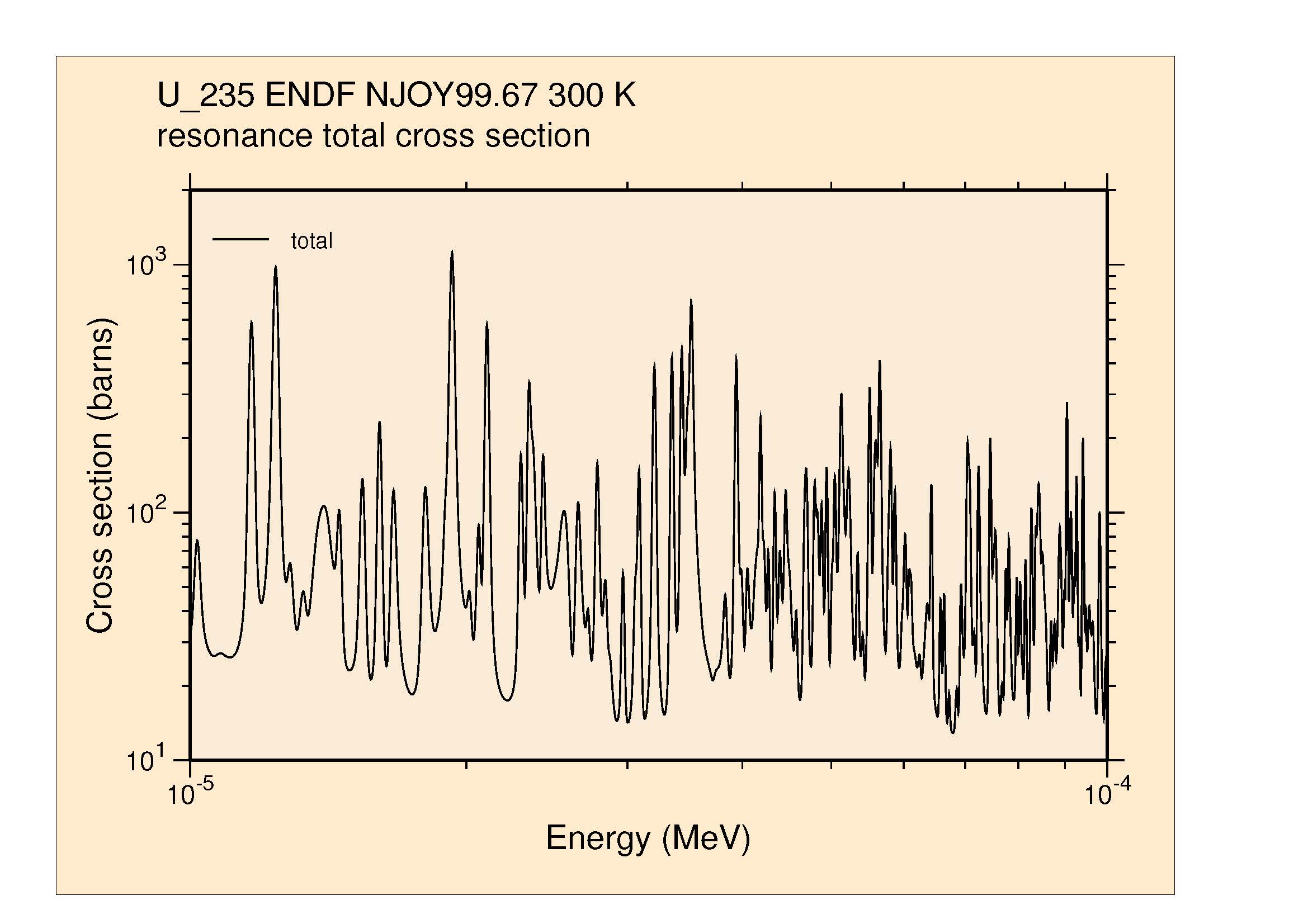
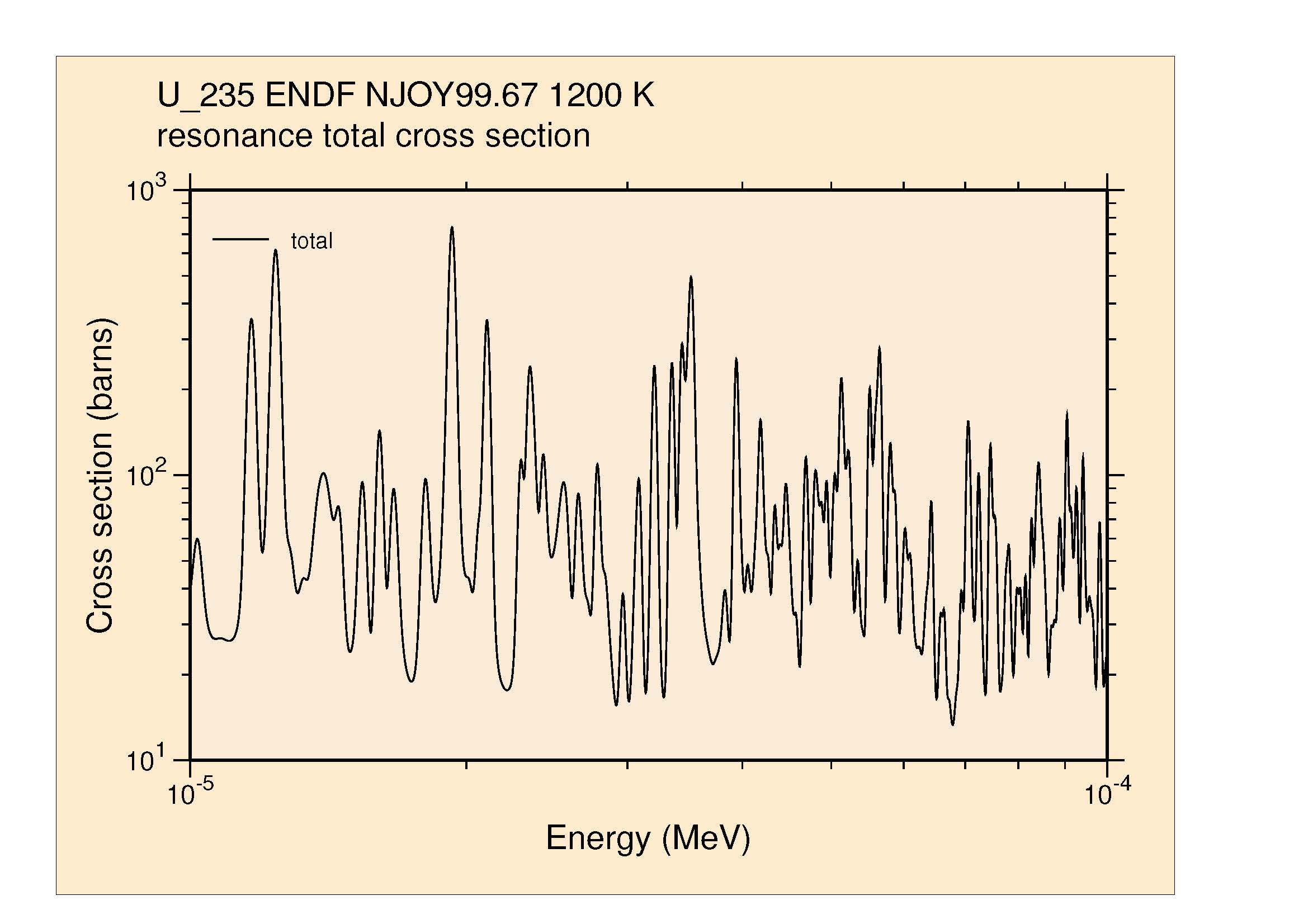
The probability of a neutron interaction, i.e. its cross section, is dependent on the material and the incident neutron’s energy. For many materials, the cross section is also highly dependent on temperature. In particular, Doppler broadening of the resonance regions in nuclear fuel can have a significant effect on the criticality of a reactor. Either AMPX or NJOY99 can process and plot the cross sectional information at a variety of temperatures. For example the U total neutron cross section at room temperature ( 300 kelvin) and at 1200 kelvin processed by NJOY99 is presented in Figures 1.9 through 1.12. For all of the possible energies, it is difficult to see a difference in the total cross sections at different temperatures in Figures 1.9 and 1.10. However if we focus on Figure 1.12, the resonance cross sections, we will see a difference. Look closely at the width of the peaks plotted at 300k versus 1200k. Notice how the peaks are sharper at the lower temperature and broader at the higher temperature. Although this may not seem important now, you will see later on that this Doppler broadening of the resonances is very important to the stability and safety of a reactor.
References
Full bibliography- LANL, G. T.-. N. D. (2007). Nuclear information service los alamos. URL: https://t2.lanl.gov/nis/
- Duderstadt, J. J. and Hamilton, L. J. (1976). Nuclear Reactor Analysis, Wiley New York. https://books.google.com/books?vid=ISBN0471223638
- Evans, R. D. (1955). The Atomic Nucleus, McGraw-Hill. https://books.google.com/books?q=intitle:%22The+Atomic+Nucleus%22+inauthor:Evans
- Murray, R. L. and Holbert, K. E. (2016). Nuclear Energy an Introduction to the Concepts, Systems, and Applications of Nuclear Processes, seventh edn, Elsevier. https://books.google.com/books?q=intitle:%22Nuclear+Energy%22+inauthor:Holbert