
On this page
These are the end-of-chapter problems from the book, reproduced as written. Work them with the programs this chapter uses. Try it yourself at the bottom of the page loads every input listing from the chapter into an editor.
Video Tutorials
The following video tutorials are available to assist your understanding of the material from this chapter.
Julia Parser Use This video shows the parser program developed in Example 8.4 being used for a hexagonal and rectangular assembly.
SCALE Plotting Lattice Output This video details using Textpad, Excel and PSI-Plot to achieve 3D plots from SCALE output. This process is better accomplished by the parser.
Flux Mapping Note that this video details how to plot flux from F4 tallies from a hexagonal lattice output in MCNP using a text editor, spreadsheet, and PSIPlot. The process is complex and should highlight the need to write a parser program to automate the process.
MCNP Parser Flux Mapping This video details the use of a parser written in Julia to plot the flux from F4 tallies from either a hexagonal or rectangular lattice output in MCNP.
Problems
Another widely used PWR assembly on a square lattice is a Framatome 15 x 15 model. The arrangement of the fuel pins and control rod guidetubes for the Framatome model is shown below:
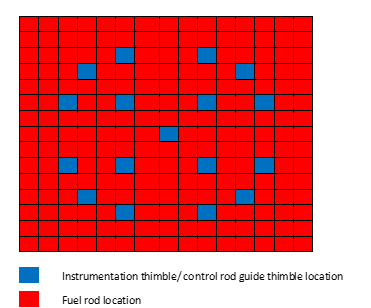
Create SCALE NEWT model of the Framatome assembly using the dimensions and specifications for the unit fuel cell and the instrumentation/ control rod guide tube unit cells from Example 8.1 in the text.
Given the PWR assembly from Problem 1, re-run the calculations in t-NEWT to calculate the fuel temperature coefficient for the infinite reactor model. Use an SN=6 quadrature and adjust the fuel temperature from room temperature (293 K) to 2093 k in increments of 200 k.
Change the density of the water in the assembly in Problem 1 from 1.0 g/cm down to 0.5 g/cm by a step interval of 0.05 g/cm. Run each model and record and plot the results where void is 1.0 - density in the x-axis. Use the slope of a trendline to estimate the void coefficient as the change in reactivity as a function of percent void.
Complete a burnup calculation on the assembly from Problem 1 using the TRITON module for SCALE. Use an appropriate specific power, plot the results and note where the reactor goes subcritical.
Use the Julia parser program presented in Example 8.4 to plot the relative flux and fission power for the assembly from Problem 1.
Add six control rod guide tubes evenly spaced in the Clinch River Breeder Reactor Assembly t-NEWT problem presented in Example 8.2. Plot the geometry and run the model. Report the k-infinity value for the assembly.
Complete a fuel temperature coefficient calculation on the SCFR model from Problem 4 using the parameters in problem 2 and plot the results.
Complete a void coefficient calculation on the SCFR model from Problem 4 using the parameters in problem 3 and plot the results. Is the coefficient positive or negative? Does it make sense?
Complete a burnup calculation on the assembly from Problem 4 using the TRITON module for SCALE. Use an appropriate specific power, plot the results and note where the reactor goes subcritical.
Use the Julia parser program presented in Example 8.4 to plot the relative flux and fission power for the assembly from Problem 4.
Try it yourself
Every input listing in Chapter 8 (32, in SCALE, MCNP, Julia) is loaded below. Pick the one a problem builds on, edit it, and take it to your machine to run. MCNP decks can be hovered line by line, and they are checked as you type by the OWEN rule set, the same checks the OWEN editor extension runs. The browser does not run MCNP.
Clinch River Breeder Reactor Project Unit CellC Computational Design in Nuclear Engineering Example 8.2C ----------------------------CELL CARD BLOCK----------------------------------C DU BLANKET ROD on TOP4 4 -10 -1 10 $DU BLANKET FUEL on TOP5 2 -7.8 1 -2 10 $SS CLADDINGC FUEL ROD13 4 -10 -1 9 -10 $PuO2 + UO214 2 -7.8 1 -2 9 -10 $SS CLADDINGC DU BLANKET ROD on BOTTOM16 4 -10 -1 -9 $DU BLANKET FUEL on BOTTOM17 2 -7.8 1 -2 -9 $SS CLADDING18 1 -0.927 -41 #4 #5 #13 #14 #16 #17 $Na COOLANT99 0 41 -999 $VOID OUTSIDE OF UNIT CELLS999 0 999 $GRAVEYARDC ---------------------------SUFRACE CARD BLOCK--------------------------------1 RCC 0 0 -81.2 0 0 162.4 0.2921 $INNER RADIUS OF CLAD OUTSIDE R OF FUEL2 RCC 0 0 -81.25 0 0 162.5 0.32 $OUTTER RADIUS OF CLADC OUTSIDE OF UNIT CELL*41 RHP 0 0 -81.28 0 0 162.56 0 0.42 0C9 pz -45.7210 pz 45.72999 so 200 $sphere for graveyardC ------------------------------DATA CARD BLOCK--------------------------------MODE NIMP:N 1 7R 0KCODE 2000 1.3 5 55 500KSRC 0.0 0.0 0.0M1 11023.72c 1.0 $Na COOLANTC Stainless Steel, 202M2 6000.72c -0.000750 $Carbon, weight fraction7014.72c -0.001250 $Nitrogen14028.72c -0.004611 $Silicon14029.72c -0.00023414030.72c -0.00015515031.72c -0.000300 $Phosphorus16032.72c -0.000150 $Sulfur24050.72c -0.007740 $Chromium24052.72c -0.15066024053.72c -0.01710024054.72c -0.00414025055.72c -0.087500 $Manganese26054.72c -0.039153 $Iron26056.72c -0.61902126057.72c -0.01417126058.72c -0.00135028058.72c -0.034000 $Nickel28060.72c -0.01310028061.72c -0.00055028062.72c -0.00180028064.72c -0.000450C DU BLANKETM3 8016.73c 2.0 92235.73c 0.002 92238.73c 0.998 $ DUCC FUELM4 8016.73c -11.8518592235.73c -0.12392238.73c -6194238.73c -0.7594239.73c -14.594240.73c -6.6894241.73c -3.1894242.73c -1.91506394244.73c -8.7e-05
Hover a line
Each line is read as a cell, a surface, or a data card. Tap a line on a small screen.
- ●Cell cards
- ●Surface cards
- ●Data cards